The 8:00 Slot Was Held for a Truck That Never Came
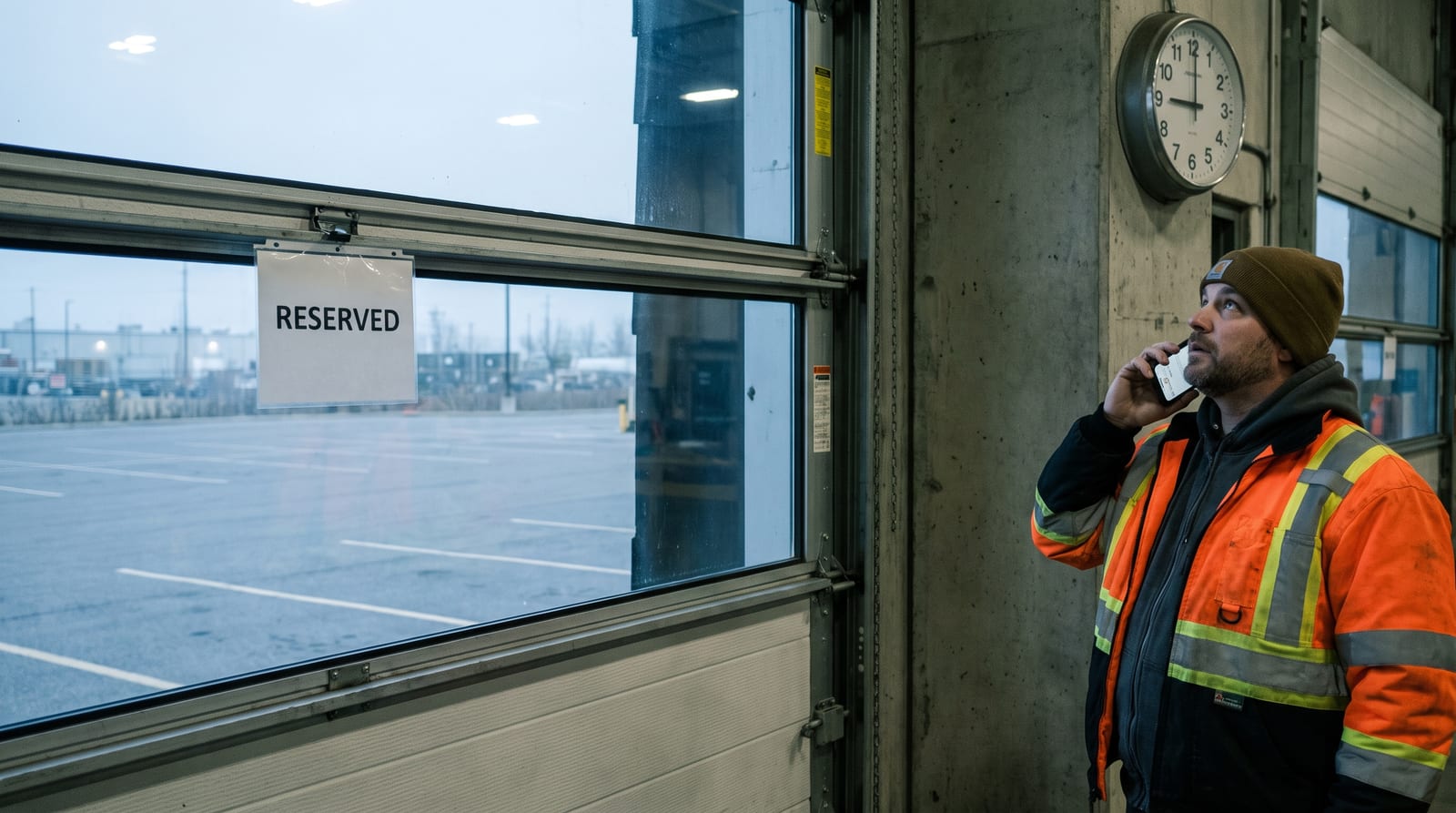
You reserved a door, staged the crew, and turned away another carrier who wanted that window. At 8:40 you call the carrier and get voicemail. At 9:15 you release the slot. That's an hour of a dock door earning nothing, on a day when you had trucks you could have booked into it. A no-show wastes a reserved slot outright. A late arrival is quieter but often worse — the truck still shows up, just far enough off schedule that it collides with the next two appointments and everything behind it slides. Both are measurable. Both come down when the booking process makes the carrier accountable for the time it reserved.
Define the two problems separately — they have different fixes
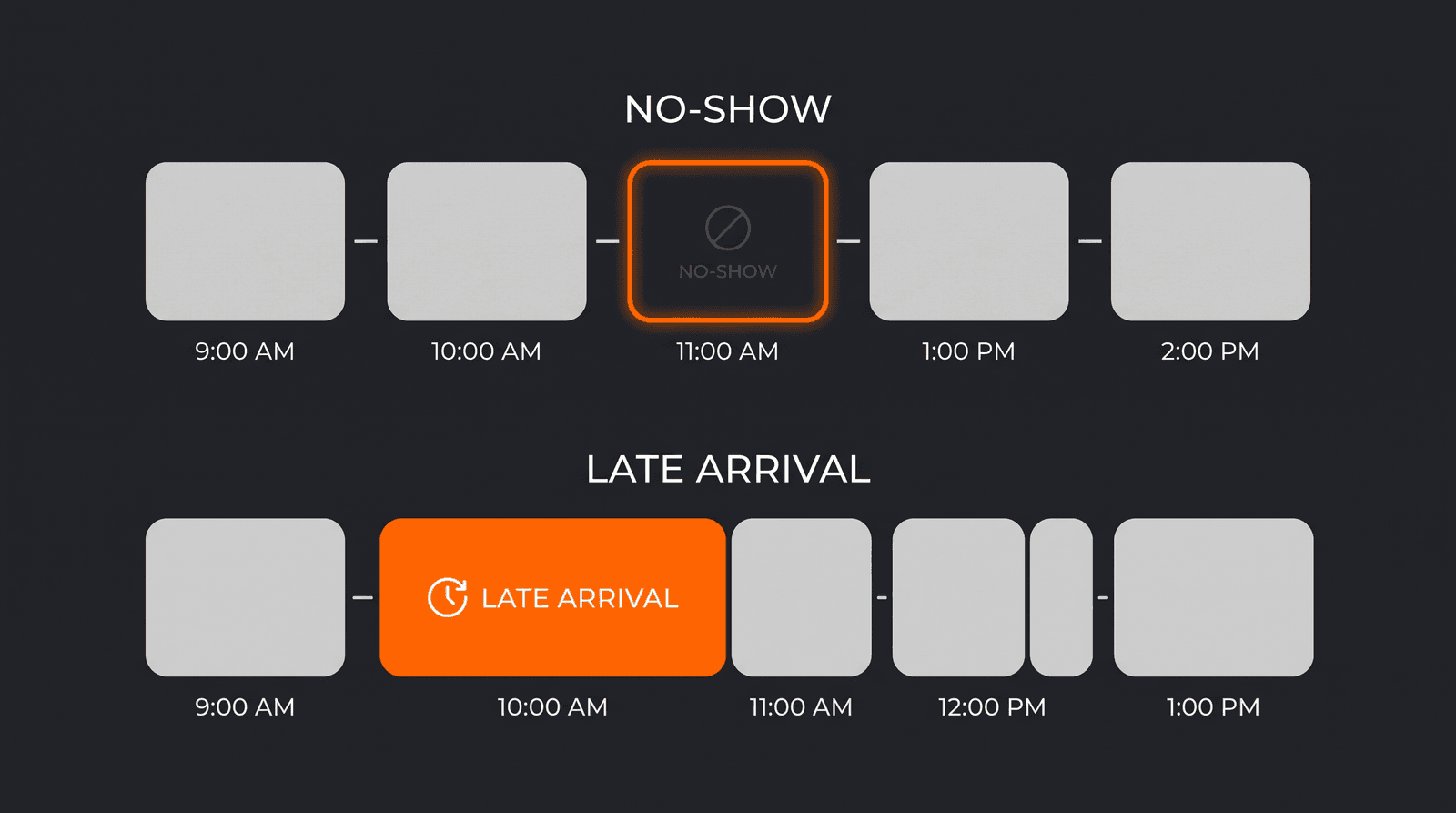
A no-show is an appointment where the carrier never arrives and never cancels in time to reuse the slot. The cost is the reserved capacity: a door held empty, staff staged for nothing, another carrier turned away. A late arrival is an appointment where the truck shows up materially outside its window — early enough to sit in your yard taking space, or late enough to land on top of the next appointment. The cost is cascade: one truck 90 minutes late in a tightly booked morning pushes every appointment behind it, and by mid-day the schedule is fiction. No-shows are mostly a commitment problem — the carrier didn't treat the booking as real. Late arrivals are partly a commitment problem and partly an information problem — dispatch planned the route without a firm appointment to build around, or the appointment wasn't visible to the driver. The reason to separate them is that a single "carrier reliability" number hides which one you actually have.
Why this is a 2026 conversation, not an evergreen one
Transportation RFP and bid season runs through the back half of the year, and the trade press covering it in August 2026 (FleetOwner, via WSI's Warehouse Wire) pushed shippers to move past pure rate negotiation and look at operational factors — naming appointment practices, dwell time, and freight consistency as the levers that actually move carrier cost and service. That cuts both ways. Carriers are scoring your facility on how predictable it is to serve, and you should be scoring carriers on whether they keep the appointments they book. Neither conversation is credible without data, and the data comes from the same place: the gap between the appointment time and the actual check-in time, tracked consistently over weeks.
A concrete scenario: one late truck and a schedule that stopped meaning anything
Picture a distribution center with seven dock doors receiving 25 inbound trucks a day, appointments booked by phone and email and tracked on a shared spreadsheet. The coordinator does a good job with what she has. The spreadsheet shows today's 25 appointments in order.
The 7:00am appointment doesn't show. She calls at 7:30 — voicemail. She holds the door until 8:00, then lets a 9:00 truck that arrived early take it. She means to go back and mark the 7:00 as a no-show, but three more trucks check in and she doesn't. At the end of the week, if someone asked how many no-shows the facility had, the honest answer is "a few, I think" — the record doesn't hold them because the no-shows are precisely the appointments that never generate a check-in line.
Meanwhile the 8:30 appointment arrives at 10:05. The two trucks booked for 9:00 and 9:30 are already on site. Now three trucks are competing for doors that were scheduled for one truck each, and the coordinator is triaging in real time. The 10:00 and 10:30 appointments arrive on time into a dock that's already an hour behind, so they wait too. By noon the schedule on the spreadsheet has no relationship to what's happening on the dock, and two afternoon trucks will bill detention for a wait that started with one truck being 95 minutes late this morning.
At the next RFP, someone will say "our carriers are unreliable." That's probably true for some of them. But the facility can't say which ones, by how much, or whether some of the lateness is its own schedule collapsing under the first late arrival — because it never had the data to tell those apart.
The mechanism: measurement first, then accountability
You can't reduce what you can't see, and the thing to see is one number per appointment: scheduled time minus actual check-in time.
No-show rate. Per carrier, the share of booked appointments where the truck never arrived and never cancelled in time to rebook. This needs a booking record and an arrival record that are linked, so an appointment with no matching check-in is automatically visible as a no-show instead of quietly disappearing.
On-time percentage. Per carrier, the share of arrivals that land inside your on-time window — pick one your dock can actually absorb, say 30 minutes early to 15 late. Tracked over several weeks this separates carriers with a genuine pattern from one-off bad days, and it surfaces time slots that are structurally hard to hit regardless of carrier.
Cascade check. When arrivals are on time but trucks still wait, that's your throughput, not carrier behavior. The same data catches it, and it's worth ruling out before any carrier conversation.
Once you have the numbers, accountability is straightforward. A carrier that books its own slot from live availability has made a commitment on its own system, not a time someone wrote down for it. A clear booking confirmation removes the "we had it down for 9:00" excuse. And a carrier that knows you track no-shows by name behaves differently than one that assumes nobody's counting. Most of the reduction comes from structured booking plus visible accountability — not from anything exotic.
What Dock-Scheduler does and doesn't do here
Dock-Scheduler gives you the inputs:
Carrier self-booking from live availability makes the appointment the carrier's commitment, booked on their initiative from the windows that are genuinely open.
Facility-based scheduling by dock door means every appointment has a scheduled time and an assigned door on record before the truck arrives.
Timestamped check-in workflows capture the actual arrival time automatically, so the scheduled-versus-actual gap exists for every truck without anyone maintaining it by hand.
Broker Portal export lets you pull schedule and check-in history to CSV or Excel to build the per-carrier on-time and no-show view.
Be direct about the limit. Dock-Scheduler does not produce automated carrier scorecards or on-time dashboards today — that reporting is part of the Yard Management System listed as "Coming Soon." It does not predict which carriers will no-show, and it does not send automated arrival reminders to drivers. What it does is capture, per appointment, the scheduled time and the automatic check-in time — the raw material every no-show and on-time metric is built from, which a spreadsheet updated from memory can't reliably give you.
If you're building the case for a carrier conversation at RFP time, start by making sure your own dock isn't the variable — getting more throughput from the doors you have and what drives loading dock congestion cover the facility side. New to structured scheduling entirely? Start here.
Frequently Asked Questions
What counts as a carrier no-show at a dock?
An appointment where the carrier neither arrives nor cancels with enough notice for you to reuse the slot. The practical test is whether you could have booked another truck into that window if you'd known it was coming free. A carrier that cancels the evening before is a scheduling change; a carrier that simply doesn't show and doesn't answer the phone is a no-show, and it costs you the reserved door plus whatever crew you staged for it.
How do I measure my carrier no-show rate?
Track, per appointment, whether the carrier arrived at all and whether any cancellation came with enough notice to rebook the slot. No-show rate is no-shows divided by total booked appointments, and it's most useful broken out by carrier and by day of week. You need a booking record and an arrival record to calculate it — a shared spreadsheet where the coordinator updates status from memory won't give you a reliable number, because the no-shows are exactly the appointments nobody remembers to go back and mark.
How do I measure carrier on-time arrival?
Compare the scheduled appointment time to the actual check-in timestamp for every truck, then define an on-time window — commonly 30 minutes early to 15 minutes late, but set it to what your dock can actually absorb. On-time percentage is arrivals inside that window divided by total arrivals. Tracked per carrier over several weeks, it tells you which carriers to talk to and which time slots are structurally hard to hit. This requires an automatic check-in timestamp; a handwritten gate time isn't precise enough to build the metric on.
How do you actually reduce carrier no-shows?
Three things move the number. First, make the carrier book the slot themselves from live availability, so it's their commitment on their system, not a time your coordinator wrote down after a phone call. Second, send a clear booking confirmation with the facility, door or check-in instructions, and time, so there's no ambiguity about what was reserved. Third, track no-shows by carrier and raise it directly with the repeat offenders — a carrier that knows you're counting behaves differently than one that assumes nobody's watching. Structured booking plus visible accountability does most of the work.
Does Dock-Scheduler have carrier scorecards or on-time performance dashboards?
Not as a shipped feature today. Automated carrier performance reporting — arrival status, turn time, on-time metrics built from check-in data — is part of the Yard Management System listed as 'Coming Soon.' What Dock-Scheduler gives you now is the underlying data: a timestamped check-in per appointment against the scheduled time, plus schedule history you can export to CSV or Excel through the Broker Portal. You can build the on-time and no-show picture from that today; the automated dashboard is on the roadmap, not in the product yet.
How does reducing no-shows and late arrivals help with detention?
Directly. A carrier that arrives on time slots into an open door and doesn't run a detention clock. A late arrival lands on top of the next appointment, and now two or three trucks are waiting — some of them past their free windows — because of one truck's timing. Tightening arrival predictability is one of the cleaner ways to reduce detention your facility would otherwise cause; the mechanism is covered in more depth in [how dock scheduling reduces detention and demurrage charges](/resources/reduce-detention-demurrage-dock-scheduling).
What if the late arrivals are my facility's fault, not the carrier's?
That's worth checking before you take it to a carrier. If your check-in data shows trucks arriving on time but waiting an hour for a door, the problem is dock throughput, not carrier reliability, and the fix is on your side — spreading appointments, assigning doors, adding capacity in the tight windows. The same appointment-versus-actual data that measures carrier behavior also measures your own. Don't open the carrier conversation until you've ruled out that your schedule is the thing making punctuality impossible.
Turn 'Carriers Are Unreliable' Into a Number You Can Act On
Every appointment gets a scheduled time and an automatic check-in timestamp. The gap between them — per carrier, over weeks — is your no-show and on-time picture. Dock-Scheduler captures it for $149.99/month flat, unlimited facilities, no demo required.