You Can't Argue a Detention Charge You Didn't See Coming
A truck books a 10:00am unload. It checks in at 9:55. Every door is full, and the two appointments ahead of it are both running long. By the time a door clears it's 12:40, well past the two-hour free window, and the detention clock has been running for forty minutes. Nobody at the dock decided to make that carrier wait — it happened because four trucks were effectively scheduled into the same 90-minute block and nothing spread them out. The charge shows up two weeks later with no arrival record to check it against. Detention is expensive, it's often billed on facts you can't verify, and a large share of it traces back to how arrivals were scheduled in the first place.
What detention and demurrage actually cost
Detention is what a carrier bills when its truck and driver are held at a facility beyond an agreed free window — typically around two hours, after which the rate commonly runs $50 to $100 per hour, per general industry research and the figures Dock-Scheduler's other resource pages use. Industry research attributed to the American Transportation Research Institute has put the total cost of driver detention at more than $15 billion a year, with roughly 135 million hours lost in a single recent year and detention affecting a large share of truckload stops. Demurrage is the related charge on the ocean side — assessed when a loaded container sits at a port or terminal past its free time — and it's governed by carrier and terminal tariffs, not by your dock. The two get mentioned together because they're both "you held my equipment too long" charges, but a warehouse's appointment process has direct leverage over one and only indirect leverage over the other. None of these figures have been independently re-verified by Dock-Scheduler against primary sources; treat them as directional industry signals, attributed generally.
>$15B
estimated annual cost of driver detention to the industry (ATRI, via industry reporting)
~2 hrs
typical free window before detention billing starts
$50-100/hr
common detention rate after the free window
The detention news cycle in 2026 — and why it matters to receivers
Detention moved back into logistics headlines in August 2026. The FMCSA sent a broker-transparency rule to the White House on August 27 that would require detention to be itemized and documented per transaction rather than bundled into a single accessorial line (FreightWaves, CCJ). Separately, trade coverage that month discussed a D.C. Circuit decision in a case involving Evergreen and the Federal Maritime Commission that, as reported, kept the burden on ocean carriers to show their demurrage-and-detention fees serve a compensatory purpose — the exact date of that ruling could not be independently confirmed here, so treat it as August-2026 context rather than a pinned fact. The common thread: the charges are getting more visible and more contestable on both the trucking and ocean sides, which raises the value of a facility being able to produce its own arrival and departure record instead of accepting whatever timeline lands on the invoice.
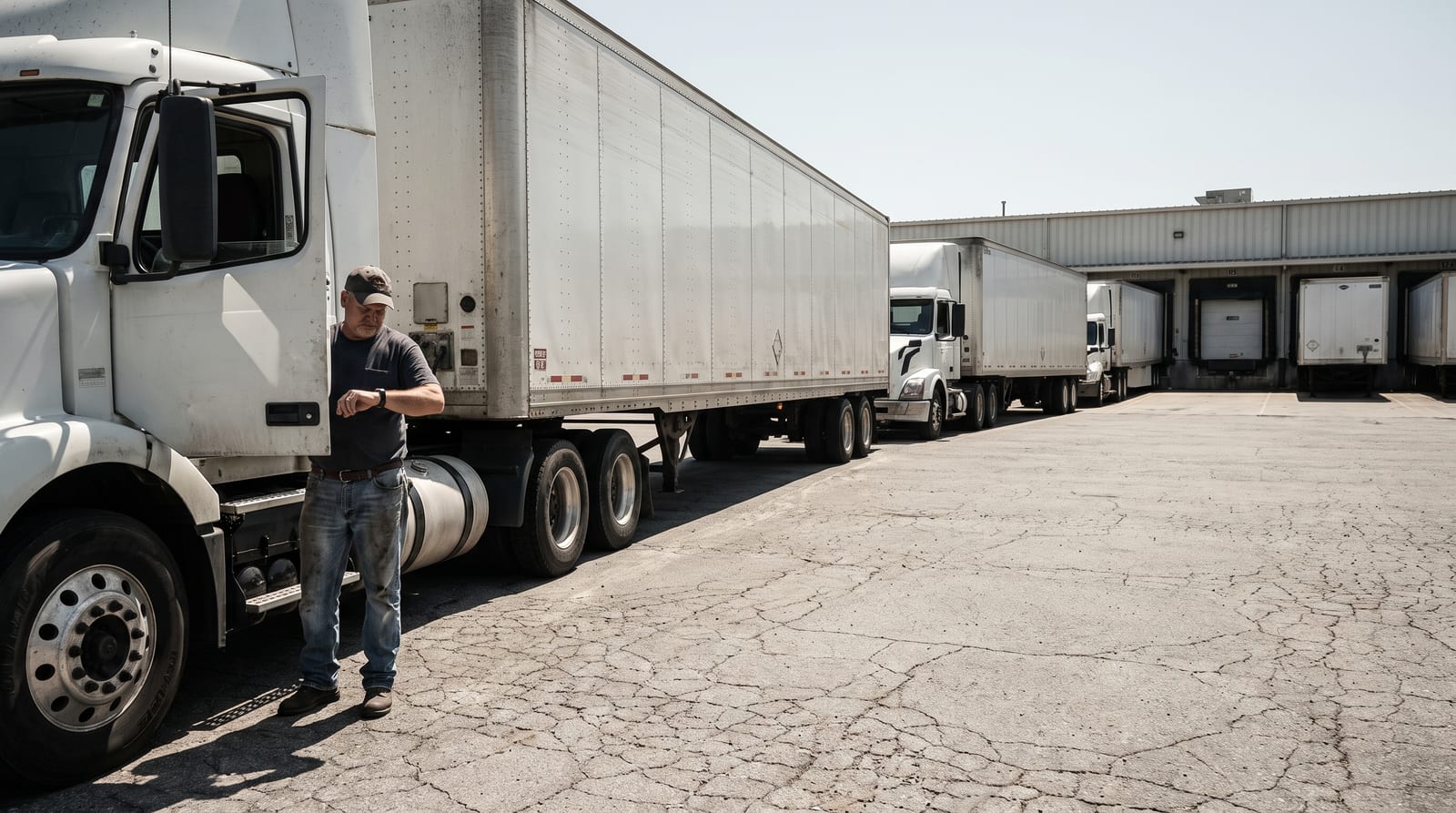
A concrete scenario: four trucks, one window, one detention bill
Picture a regional distribution center with six dock doors, receiving about 30 inbound trucks a day. Carriers book by calling the coordinator, and almost all of them ask for a morning slot because that's what their own dispatch prefers. The coordinator says yes to most of them, because there's no view of how full the morning already is — just a list.
On a normal Wednesday, 18 of the day's 30 trucks are booked between 7:00am and 10:00am. Six doors, three hours, roughly 45 minutes a truck when everything goes right — the math only works if nothing runs long and every truck shows on time. Neither happens. A 7:00 unload takes 90 minutes because the load was floor-stacked. An 8:30 truck arrives at 8:10 and parks. By 9:00 there are four trucks on site waiting for a door and two more booked to arrive in the next thirty minutes.
The truck that booked 9:00 checks in at 8:55 and doesn't get a door until 11:20. Its free window ran out at 10:55. The carrier bills 90 minutes of detention. When the invoice arrives, the DC has the original 9:00 appointment on the spreadsheet and nothing else — no check-in time, no record of which door it eventually used, no departure time. The 90 minutes is probably accurate. It might be 60. There's no way to tell, so it gets paid.
Nothing about that day required more doors or more staff. Eighteen trucks in three hours was always going to back up. Spreading them across the full operating day — and being able to see the morning was full before saying yes to the nineteenth request — is what would have prevented most of it.
The mechanism: three separate things scheduling changes
Detention at your own dock comes down to how long a truck waits past its free window. Appointment scheduling works on that in three distinct ways, and it's worth separating them because they solve different parts of the problem.
It spreads arrivals to match capacity. When carriers book from live availability instead of calling for whatever slot they want, appointments distribute across the operating day rather than stacking into the first three hours. A truck that arrives into an open door doesn't run a detention clock. This is the same clustering dynamic covered in loading dock congestion: causes and fixes — arrivals bunching beyond what the dock can absorb in a window.
It gives every appointment a door. Assigning a specific door to each booking means there's a plan when the truck arrives, not a walk-the-dock scramble to find somewhere to put it. Ad hoc assignment is how a truck that could have turned in 45 minutes ends up waiting behind whichever truck the coordinator dealt with first.
It creates the record. Every appointment gets a timestamped check-in and check-out. That doesn't prevent detention, but it changes what happens when a charge comes: you have a specific timeline to verify a legitimate invoice fast, or dispute an inflated one with evidence. In 2026, with detention getting itemized and scrutinized on both the trucking and ocean sides, that record is worth more than it used to be — see the FMCSA broker transparency rule and what it means for receivers.
Where scheduling doesn't help: be honest about the cause
Structured scheduling reduces detention that's caused by arrival clustering and missing door plans. It does not touch detention caused by:
- Not enough dock labor. If two people are unloading six doors, trucks wait no matter how well the schedule is built.
- Slow equipment or process. A forklift down, a congested staging area, a receiving inspection that takes 40 minutes per load — scheduling makes these visible sooner but doesn't fix them.
- Real capacity shortfall. If you genuinely receive more trucks per day than your doors can cycle, the schedule just tells you that earlier. The fix is capacity, staffing, or volume — covered in getting more dock throughput when you can't lease more space.
The practical step is to categorize your own detention by cause for a month. If most of it clusters in your busiest booking windows, scheduling is the lever. If it's spread evenly across the day, the problem is downstream of the appointment and a scheduling tool won't produce the number a vendor's case study promises.
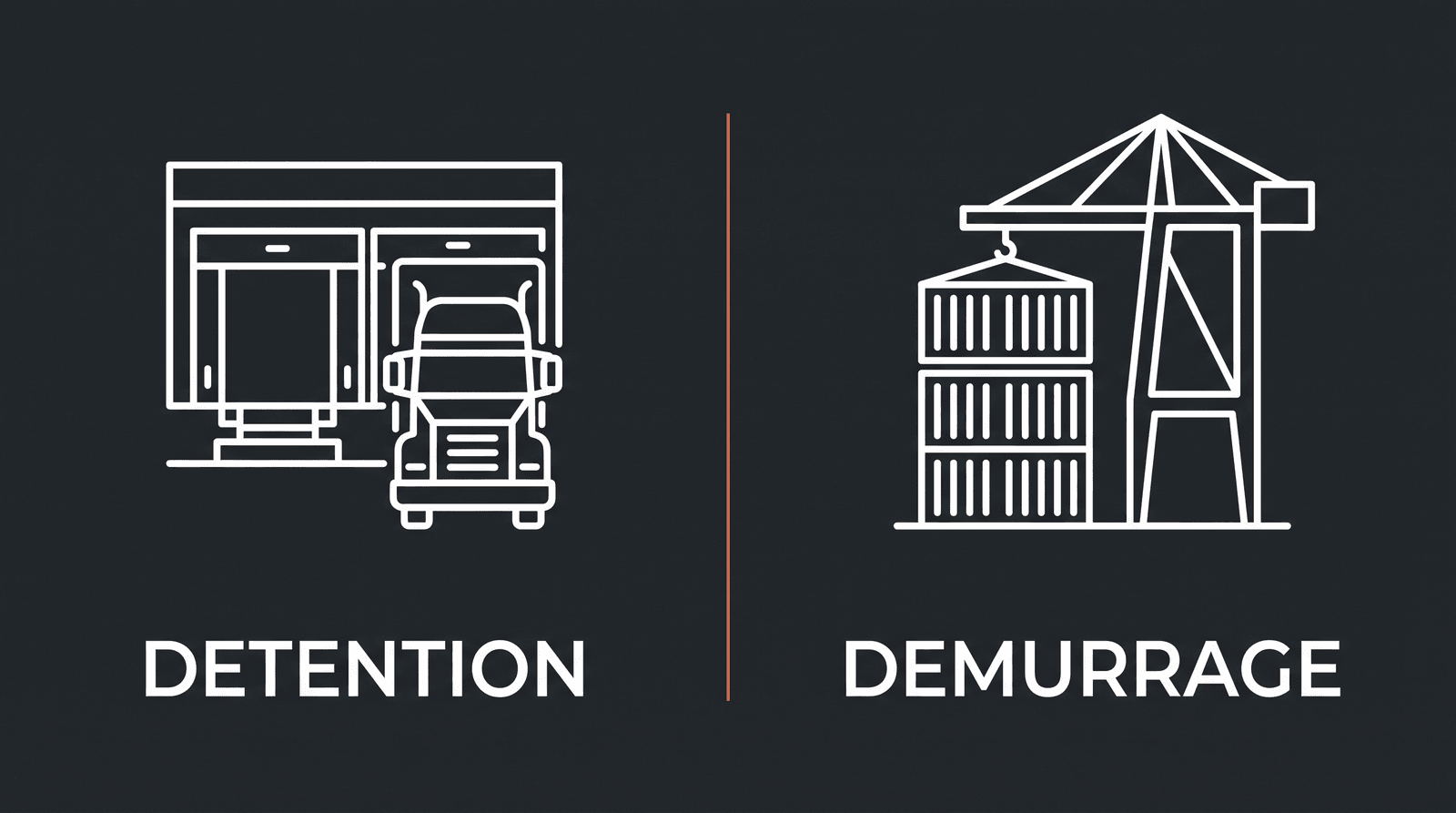
On demurrage specifically
If your facility receives import containers off drayage, the demurrage question is different. Demurrage is charged by the ocean carrier and terminal when a container sits past its free time, under their tariff, and the dispute process runs through them. Your dock affects it only at one link in the chain: how fast you unload the container and free it to be returned. A predictable dock schedule makes that turn faster and removes your facility as the reason a container is late going back. It does not give you leverage over port congestion, chassis shortages, or the demurrage tariff itself — those sit well outside the appointment layer.
The fix, mapped to what's actually shipped
Dock-Scheduler addresses the appointment layer directly:
Carrier self-booking from live availability spreads arrivals across the day instead of concentrating them where dispatch prefers.
Facility-based scheduling by dock door puts a specific door on every appointment before the truck arrives.
Real-time appointment visibility shows the coordinator how full a window already is, so the nineteenth morning request gets moved to the afternoon instead of rubber-stamped.
Timestamped check-in workflows capture arrival, door, and departure per appointment — the record a detention claim gets measured against.
It's worth being direct about the limits. Dock-Scheduler does not auto-optimize your bookings — there's no engine reshuffling appointments on its own. It does not produce carrier on-time scorecards today; automated carrier performance reporting is part of the Yard Management System listed as "Coming Soon," not a shipped feature. And it does not manage demurrage, file disputes, or set your free-time terms. What it does is remove your dock as the cause of detention it has control over, and give you the record for the charges that still come through.
New to the category? What dock scheduling software actually does covers it from the ground up. Still on a spreadsheet? Start here.
Frequently Asked Questions
How does dock scheduling software reduce detention charges?
Through three mechanisms. First, it spreads arrivals across the operating day instead of letting them cluster, so a truck is less likely to wait behind three others that all booked the same window. Second, it assigns each appointment to a specific dock door, so there's a plan for where the truck goes rather than a scramble when it arrives. Third, it captures a timestamped check-in and check-out per appointment, which is the record you need to verify or dispute a detention claim. The first two reduce how often detention happens; the third changes what you can do about the charges that still come.
How much can appointment scheduling actually cut detention? I've seen claims of 30 to 50 percent.
Vendors publish figures in that range, and they're plausible for a facility going from unmanaged arrivals to a structured schedule — but they depend heavily on the starting point and the cause of the detention. Dock-Scheduler doesn't claim a specific percentage, because the honest answer is that it varies. If your detention is driven by arrival clustering and no door plan, structured scheduling addresses that directly. If it's driven by understaffing, slow unload equipment, or volume that genuinely exceeds your dock capacity, scheduling helps at the margin but won't produce a headline number. Measure your own detention by cause before assuming a percentage.
What's the difference between detention and demurrage?
Detention is charged by a trucking carrier when its truck and driver are held at a shipper or receiver beyond the free window — usually about two hours. Demurrage is charged on the ocean side when a loaded container sits at a port or terminal past its allotted free time, under the carrier's or terminal's tariff. A warehouse's appointment process directly affects detention at its own dock. It affects demurrage only indirectly — a faster dock turn means an import container gets unloaded and the empty returned sooner, but the demurrage clock and dispute process sit with the ocean carrier and terminal, not your facility.
Does dock scheduling help with demurrage on import containers?
Only indirectly, and it's worth being precise about that. If your facility receives drayed import containers, getting them unloaded and turned quickly helps you return equipment before free time runs out — and a predictable dock schedule makes that turn faster. But demurrage is assessed by the ocean carrier and terminal under their tariffs, the disputes go through them, and factors well outside your dock — port congestion, chassis availability, drayage capacity — often drive the charge. Scheduling your dock well removes your facility as the bottleneck; it doesn't give you control over the demurrage process itself.
If a detention charge is wrong, how does a check-in record help?
A detention invoice states an arrival time and a release time and bills the gap beyond the free window. If your only record is a booked appointment time and a handwritten gate log, you can't credibly contest those numbers. A timestamped check-in and check-out captured automatically per appointment gives you a specific, defensible timeline to compare against the claim — which lets you verify a legitimate charge quickly or dispute an inflated one with evidence instead of a guess.
What detention causes can't scheduling software fix?
Detention driven by not having enough dock labor to unload on time, by slow or broken material-handling equipment, by a receiving process that inspects and puts away too slowly, or by inbound volume that genuinely exceeds how many trucks your doors can handle in a day. Structured scheduling can make those problems visible sooner and stop clustering from compounding them, but it doesn't add headcount, speed up a forklift, or create dock capacity that isn't there. If your detention persists with a well-organized schedule, the cause is downstream of the appointment.
Stop Detention Before It's an Invoice You Can't Check
Spread arrivals so trucks aren't waiting on each other, assign every appointment a door, and capture a timestamped check-in and check-out on every visit. Dock-Scheduler does that for $149.99/month flat, unlimited facilities, no demo required.